

What Sennheiser's Latest Announcements Mean for Enterprise Audio Visual
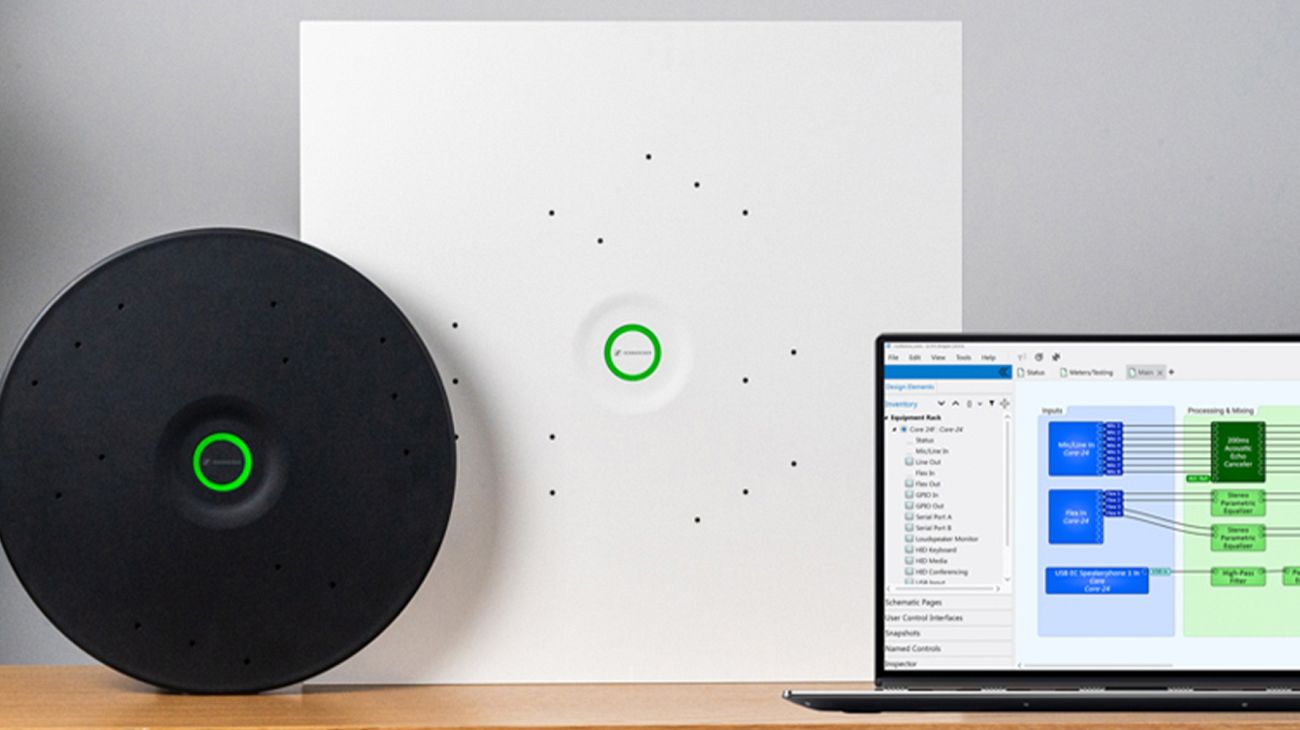
Sennheiser has made three significant announcements for its Business Communication portfolio: the TeamConnect Ceiling M Plus, PartnerLink, and DeviceHub.
Individually, each addresses a real and familiar pain point in how organisations deploy and manage audio visual technology. Together, they reflect a clear direction of travel, one that is worth understanding if you are responsible for meeting room audio at scale.
InfoComm 2026 in Las Vegas served as the moment Sennheiser brought these announcements together under a single narrative, though the TCC M Plus and its companion capabilities had been introduced to the market in early June, ahead of the show. The convergence at InfoComm simply provided the context for understanding how the three fit together.
TeamConnect Ceiling M Plus: A Practical Step Forward for Ceiling Microphones

The TeamConnect Ceiling M Plus (TCC M Plus) is engineered for medium and large collaboration spaces. It arrived at InfoComm having already won three industry awards, which serves as recognition that speaks to what it actually delivers rather than what it promises: the SCN Installation Product Award for Most Innovative Audio Hardware, the Higher Ed AV Award for Best Microphone Product, and Future's Best of Show Award.
Clarity of sound is where the hardware earns its credibility. The TCC M Plus uses 15 SMD electret condenser capsules to cover up to 60m² (645 sq. ft.), with a radius of 4.3m. Coverage figures alone, however, rarely tell the full story of how a microphone performs in practice. The updated dynamic beamformer is the more meaningful specification here: it adapts to changing room layouts and participant positions automatically, without requiring manual reconfiguration. In spaces where furniture is rearranged regularly or where room dividers are in use, that adaptability has a direct operational value. Improved camera tracking accuracy at distance also makes a material difference in hybrid meetings, keeping remote participants reliably connected to whoever is speaking.
Intelligent Noise Control manages predictable background sources (HVAC systems, projectors, etc) so they do not degrade speech intelligibility. Enhanced exclusion zones give administrators more precise control over which areas of a room the microphone actively picks up, which is particularly useful in open-plan and divisible environments.
Simplicity of installation has also been addressed directly. Single cable mode and daisy chaining reduce cabling complexity, switch port requirements, and infrastructure costs, three variables that routinely determine whether a deployment is straightforward or becomes a project management problem. Four installation formats (flush round, flush square 60cm, flush square 2ft, surface, and suspended) mean the device can fit most ceiling environments without requiring custom solutions. Configuration is handled through a browser-based interface with no additional software, which lowers the technical barrier for IT and AV teams. A configurable standby mode reduces energy consumption when rooms are not in use.
Security is covered through SSCv2, Sennheiser's secure API standard, and Dante encryption for audio over IP, which is an increasingly relevant requirement as enterprise IT policies extend further into AV infrastructure.
PartnerLink: Reducing Friction at the Point of Integration

A capable microphone that is awkward to integrate into existing AV platforms creates unnecessary friction at deployment. PartnerLink is Sennheiser's response to that problem.
PartnerLink enables supported Sennheiser products to be configured directly within selected third-party AV platforms, launching initially with Q-SYS Designer. The integration was developed in close collaboration with Q-SYS, and allows the TCC M Plus to be configured alongside Q-SYS native components in a single environment. This development removes the need for installers to move between separate systems.
For systems integrators who already work within established platform ecosystems, this matters. Adding a new product to a deployment should reduce workflow steps, not introduce new ones. PartnerLink is designed as a scalable framework, with additional platform integrations planned over time, which suggests Sennheiser intends this to extend well beyond its initial Q-SYS scope.
DeviceHub: Making Fleet Management Manageable

As collaboration spaces multiply across organisations, across floors, buildings, and regions, the operational question of how to manage audio devices at scale becomes increasingly pressing. DeviceHub is Sennheiser's cloud-based platform for doing so.
Browser-based and designed for remote management, DeviceHub provides real-time device status, health monitoring, and alerts without requiring engineers to be on site for routine tasks. Its location management capability maps buildings, floors, rooms, and devices into a structured interface that allows AV and IT teams to locate and manage specific devices quickly, a practical requirement for anyone overseeing a large, distributed estate.
The platform is built on Microsoft Azure enterprise-grade cloud infrastructure, with end-to-end encryption, secure authentication, and GDPR-compliant data protection. Role-based access control replaces shared logins with individual user accounts and clearly defined permissions across AV teams, IT staff, and service providers, reducing both security risk and operational ambiguity.
DeviceHub is built to scale from a small number of rooms to global, multi-region deployments. Devices, sites, and users can be added as the organisation grows, which means it does not need to be replaced as requirements change.
Why It Matters as a Whole
Considered together, these three announcements address the full lifecycle of an enterprise audio visual deployment: the quality of sound captured in the room, the ease with which the hardware integrates into existing AV ecosystems, and the efficiency with which devices can be managed once deployed.
For corporate enterprise organisations, the practical value lies less in any single capability and more in the reduction of operational overhead across the board. Better hardware that is also easier to install, configure within familiar tools, and monitor remotely (without requiring specialist intervention at each stage) is the proposition worth paying attention to.
proAV is a Sennheiser partner. To find out more about how the TCC M Plus, PartnerLink, and DeviceHub could work within your organisation's audio visual environment, get in touch with our team.
Share