

Why Furniture Must Become Part of the Smart Workplace Stack

Organisations continue investing in smarter workplace strategies, workplace technology and more flexible ways of working, yet one of the most heavily interacted-with elements of the workplace is still too often considered separately from those conversations: furniture. Despite shaping how people collaborate, interact with technology and navigate different workspace settings, furniture is still frequently treated as a standalone fit-out consideration rather than part of a broader workplace strategy. Workplace technology, workplace operations and furniture specification are often approached independently, creating a disconnect between the physical environment and the systems intended to support it. As workplace expectations continue to evolve, that separation is becoming increasingly difficult to justify. A more integrated approach has the potential to deliver better user experiences, greater operational visibility and workplaces that are easier to measure, refine and optimise over time.
Where Activity-Based Working Falls Short

Activity-based working rests on a straightforward premise: give employees a range of environments suited to different types of work, and they will naturally gravitate toward the setting that best supports what they need to do. That works well when the physical, technological and operational layers of the workplace function as a coherent whole, but in many organisations, they still do not.
Collaboration areas, focus spaces and informal meeting settings may look cohesive from a design perspective, yet still operate in isolation from the systems intended to support them. The result is limited visibility into how different environments are actually being used, which settings genuinely support productivity, and where the user experience begins to break down. Furniture is typically the last element connected to that picture - if it is connected at all.
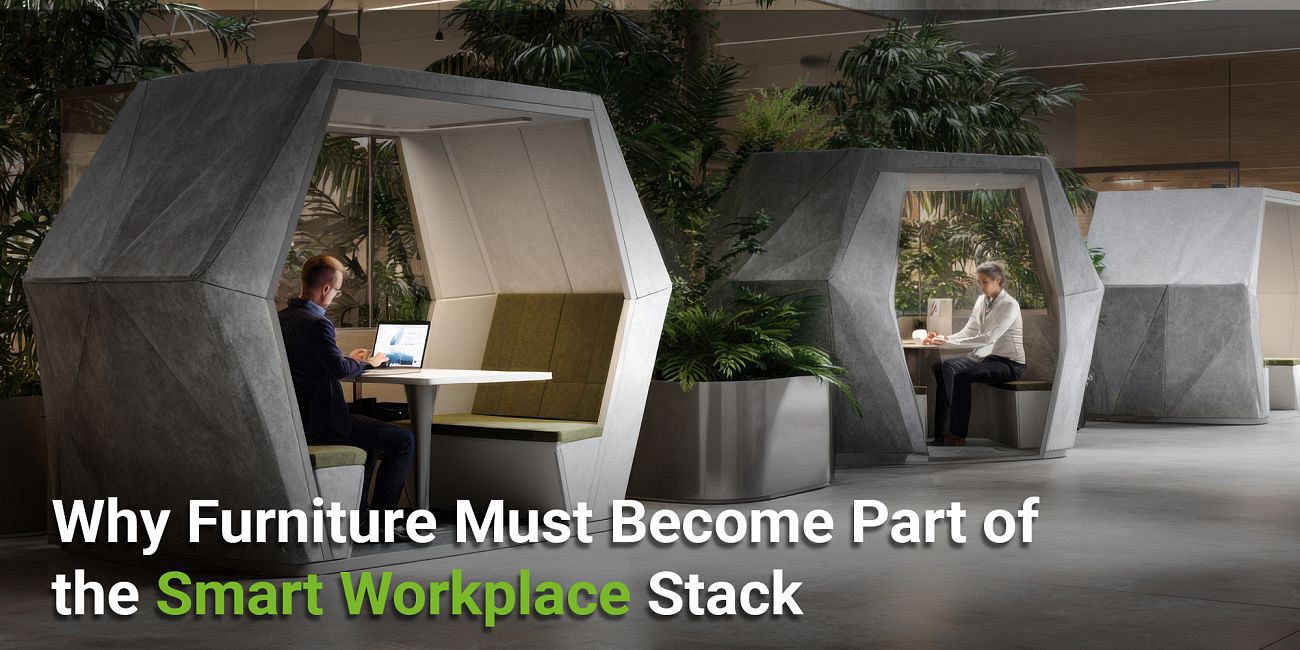
This is particularly evident with enclosed furniture settings such as meeting pods and acoustic booths. These products sit at the natural intersection of furniture and technology, often incorporating integrated screens, power and lighting, yet they are still frequently procured and managed as standalone fit-out items rather than connected components of the wider workplace. According to CBRE’s 2024–2025 Global Workplace & Occupancy Insights report, enclosed meeting room utilisation averages 58%, compared to just 23% in open areas. This suggests that employees consistently place greater value on enclosed settings for focused work and small-group collaboration than many workplace strategies currently account for.
Organisations may discover that short-duration bookings consistently gravitate toward enclosed booths rather than formal meeting rooms - a pattern that can directly influence future space ratios, procurement decisions and floorplate planning. Without integration, however, that visibility simply does not exist. A pod that cannot report on its own occupancy, or that operates independently from a room booking system, represents a missed opportunity to understand how private spaces are genuinely being used across a floor or an estate.
Bridging the Gap Between Design Intent and Operational Reality
 Space allocation decisions are almost always made during the design stage, based on projected occupancy levels, anticipated behaviours and assumptions about how different settings will be used in practice. Yet once a workplace becomes operational, those assumptions are rarely tested in any meaningful way. Manual headcounts, badge access data and periodic surveys remain the primary tools for most environments, but they provide only a partial picture of how spaces actually perform throughout the working day.
The gap between design intent and operational reality can be difficult to detect without the right visibility. Sit-stand desks that go largely unused, lounge seating that becomes informal meeting overflow, or focus booths quietly repurposed for storage are all signs that a space may be functioning differently from how it was originally planned. Integrating furniture with workplace systems creates the opportunity to surface those patterns early, understand how specific settings are genuinely being used, and make informed adjustments before inefficient decisions become embedded at scale.
Building Workplaces That Evolve Over Time

One of the most significant shifts in workplace strategy is the move away from treating office design as a single, large-scale event and toward treating it as an ongoing process of refinement. A more integrated approach makes that possible in practice. When furniture, technology and operational data are connected, patterns that would otherwise remain invisible begin to emerge: which space types are genuinely relied upon, which are underused, and where the gap between design intent and actual use is widest. Those findings can then directly shape future investment decisions, rather than waiting for a full redesign cycle to surface the issue.
That changes the economics of workplace investment considerably. Layouts, ratios and furniture typologies no longer need to be committed across an entire estate based solely on design-stage assumptions. Instead, different workspace models can be piloted, measured and adapted in real conditions, then scaled with confidence based on observable behaviour and operational performance.
Conclusion
Furniture remains one of the most heavily interacted-with elements of the workplace, yet it is still too often separated from the operational and technological strategies shaping how modern environments function. The challenge is no longer simply designing workplaces that look adaptable on paper. It is creating environments that can be measured, refined and evolved based on how people actually use them over time.
Increasingly, the organisations delivering the most effective workplaces will be those treating furniture, technology and operational planning not as separate layers, but as part of the same workplace strategy. In the future workplace, furniture will no longer be passive infrastructure. It will become a measurable, connected layer of workplace intelligence.
Share